


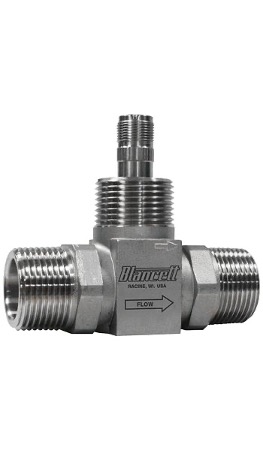
A turbine flow meter is a device for measuring volume. As liquid or gas travels through the turbine housing, it causes the blades to revolve. The velocity of the fluid traveling through the flow meter is directly proportional to the velocity of the turbine rotor.
The rotor is connected to a set of gears that transmit its rotations to a register by using a magnetic coupling. These registers can provide different outputs to reading devices like pulses, 4-20 mA (analog signals) and even encoder outputs when used in billing applications. In other applications, the flow meter’s external pickoff detects the passage of each rotor blade, leading the sensor to provide a frequency output. The frequency of a liquid or gas is directly proportional to its volume. Either a magnetic or modulated carrier (RF) pickup can be utilized to measure the turbine rotor’s rotating speed.
Depending on the flow meter application, a variety of turbine flow meters are available. And after comprehending the application, a number of criteria come into play while selecting a flow meter, including type of fluid, viscosity, pipe dimensions, and process temperature, as well as the range of flow, pressure, and accuracy.
If you need to measure volumetric total flow and/or flow rate, a turbine flow meter is the perfect instrument. Turbine flow meters can be designed to withstand tremendous pressure and extreme temperatures. They provide a high turn-down with less unpredictability and superior consistency. In addition to being simple to install and operate, turbine flowmeters require just periodic recalibration and service.
To learn more about the Avanti Company and the services and products we provide, including water meters and collection system meters, please visit us online or call us at 800.284.5231.